Research
My research focuses on developing machine learning methods for engineering applications, with emphasis on interpretability, physical consistency, and generalization to complex real-world scenarios. Below are my core research areas and selected contributions.

Research Profiles
Research Areas
Machine Learning for Aerodynamics
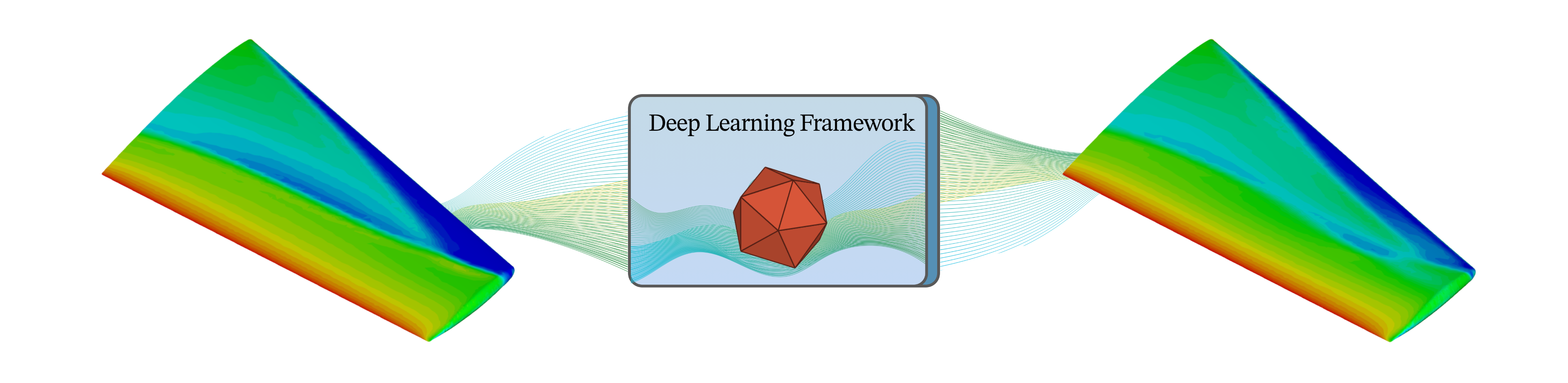
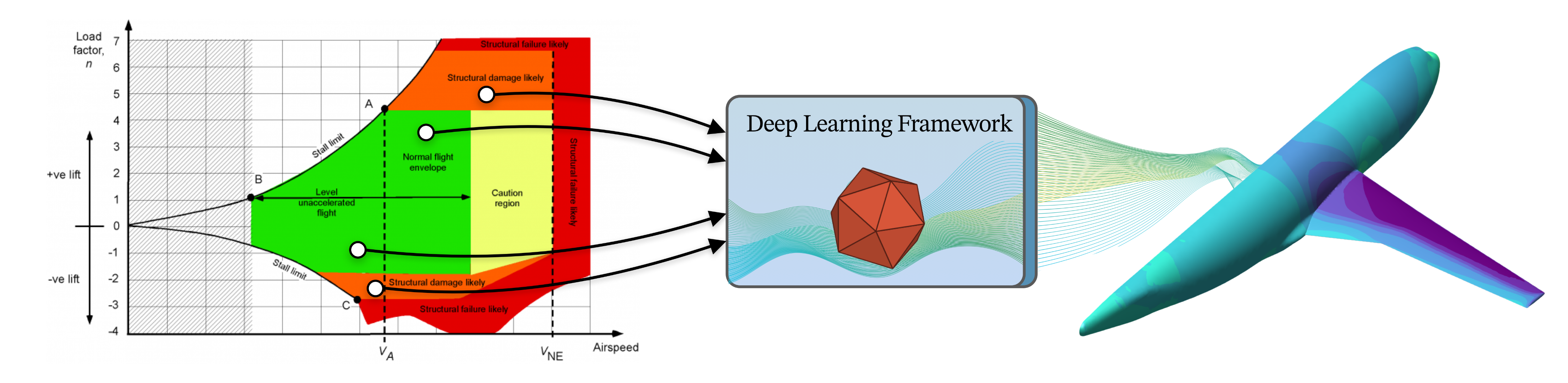
Applying deep learning and statistical methods to predict steady-state and unsteady transonic flowfields from high-resolution CFD data. This includes predicting pressure distributions, aerodynamic loads, and full flowfield solutions using neural network surrogates trained on SU2 and OpenFOAM simulation data.
Key publications: Steady-state transonic flowfield prediction (AIAA Journal, 2024), Parametric Nonlinear Volterra Series (Journal of Aircraft, 2025).
Geometric Deep Learning
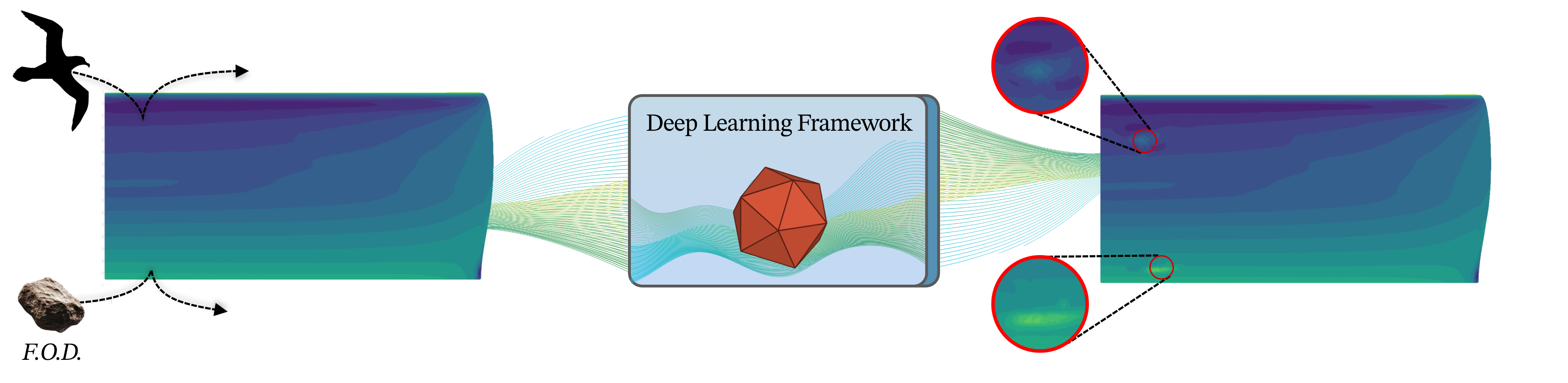
Developing graph convolutional network (GCN) architectures and autoencoder frameworks that respect the geometric and topological structure of mesh-based data. This enables predictions on non-homogeneous unstructured grids without re-meshing or interpolation, directly working with the native CFD mesh.
Key publications: Autoencoder GCN for non-homogeneous grids (J. Comp. Physics, 2025), GCN for AGARD wing deflection (AIAA SciTech 2025).
Spatio-temporal Modelling
Spatio-temporal graph convolutional autoencoders for forecasting time-varying pressure distributions on transonic wings. These models capture both spatial dependencies across the mesh and temporal dynamics of unsteady aerodynamic phenomena.
Key publications: Spatio-temporal GCN autoencoder (Aerospace Science and Technology, 2025), Generative Spatio-temporal GraphNet (arXiv, 2024).
Physics-Informed Modelling
Integrating physical principles, conservation laws, and domain constraints into machine learning models to ensure physically consistent predictions. This includes combining Bayesian neural networks with transfer learning for multi-fidelity uncertainty quantification of aerodynamic loads.
Key publications: Multi-fidelity Bayesian Neural Network (Aerospace Science and Technology, 2025).
Large Language Models & AI
Applying large language models (LLMs) and retrieval-augmented generation (RAG) for intelligent document analysis, knowledge extraction, and question-answering in engineering contexts. This includes fine-tuning and deploying transformer-based models for technical documentation and research automation.
Applications: Document chatbots, technical Q&A systems, research paper analysis.
Reinforcement Learning & Optimization
Exploring reinforcement learning methods for optimization and control problems in engineering applications, including multi-objective PID controller optimization for quadrotor UAVs.
Key publications: Multi-objective PID optimization for UAVs (arXiv, 2025).
Computational Fluid Dynamics
Extensive experience with CFD solvers (SU2, OpenFOAM) for high-fidelity aerodynamic simulations including dynamic stall, icing accretion on wavy leading-edge wings, and flutter prediction for flexible wings.
Key publications: Dynamic Stall CFD study (PhD thesis, 2020), Flutter prediction at the 3rd Aeroelastic Prediction Workshop (AIAA SciTech 2024).
Applications